Tattoo removal with Pico laser
What is Pico laser tattoo removal?
A tattoo is created by depositing pigment into the dermis — a layer deeper than the epidermis where cell turnover rarely occurs — to leave a long-lasting design on the skin. Conventional tattoo-removal treatments primarily relied on nanosecond lasers, which break down pigment using thermal energy. However, this approach carries risks of pigmentation due to heat, and the heat itself limits how strongly the laser can be applied.
Pico laser delivers ultra-short picosecond-duration pulses, locally breaking down tattoo pigment via shock waves. The fragmented pigment is engulfed by white blood cells (macrophages) and excreted from the body. Because thermal damage to surrounding tissue is reduced, Pico laser is characterized by lower pigmentation risk and the ability to deliver relatively higher output during treatment.
WORRIES — Recommended for
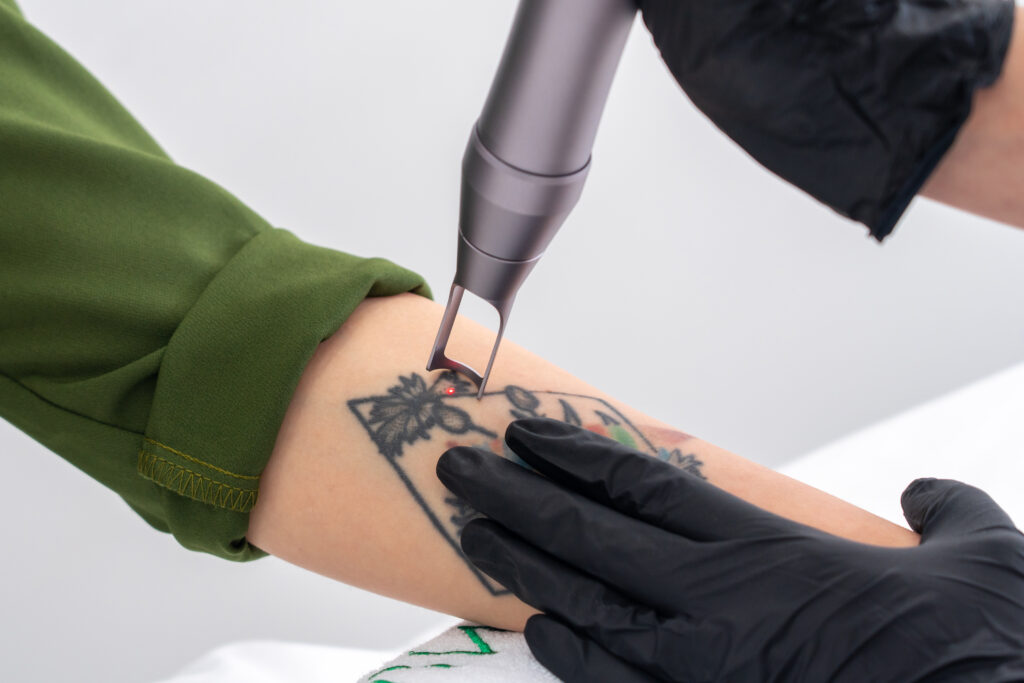
・Want tattoo removal
・Considering tattoo removal with reduced pigmentation risk
・Want tattoo removal in areas where surgical excision should be avoided
・Considering Pico laser tattoo removal
FEATURE — Key features
A pigment-targeting approach using Pico laser
Reaching the dermis through shock waves, Pico laser breaks down tattoo pigment into fine fragments. Compared with conventional nanosecond lasers, it is characterized by reduced pigmentation risk during treatment.
Treatment performed by an experienced physician
At our clinic, an experienced physician performs the laser treatment after examination. The physician takes responsibility for selecting and applying the appropriate output settings.
Short downtime
Compared with conventional nanosecond lasers, Pico laser produces less excess thermal effect, making downtime relatively short and reducing the impact on daily life.
Pain-conscious procedure
Treatment is performed after thoroughly cooling the area. For patients concerned about discomfort, local anesthesia or topical numbing cream is also available — please feel free to ask.
Important notes (risks, side effects, downtime)
| Procedure time | Approx. 10–15 minutes (varies with tattoo size) |
|---|---|
| Pain | Treatment is performed after cooling with ice packs. Topical numbing cream and local anesthesia are also available as options. |
| Downtime | For approximately 10 days after the procedure, scabs will form and blisters may appear. Do not touch or peel them, and avoid strong sunlight. Post-treatment pigmentation typically improves over 3–6 months. |
| Cautions | Showering is possible from the same day. Avoid alcohol and vigorous exercise on the day of treatment. Bathing is possible from the next day. For 2 weeks after treatment, avoid strong sunlight and use sunscreen. |
| Side effects | Pigmentation, blisters, scabs, scar formation, hypopigmentation (whitening), infection, etc. may occur. Pigmentation typically improves over 3–6 months, with individual variation. |
| Number of treatments | The number of treatments needed varies significantly with tattoo color, depth, and size, but multiple sessions (typically 5–10 or more) are generally required. |
| Persistence | Once a tattoo has been removed, it generally does not return. However, some colors (yellow, green, etc.) are difficult to fully remove, and scarring may remain in some cases. |
*The above describes a general course; pain, downtime, and effects vary by individual.
*Procedure time does not include consultation.
*Pregnant and breastfeeding patients are asked to refrain from this treatment.
FLOW — Procedure steps
We listen to your concerns and propose a plan tailored to you. Please feel free to ask any questions or share concerns.

The physician applies the Pico laser. We check in with you and proceed with attention to comfort throughout.

We recommend a follow-up examination 2 weeks after treatment. If you have any concerns before then, please come in at any time.
Physician’s comment
About Pico laser tattoo removal
A tattoo is created by depositing pigment into the dermis to leave a long-lasting design on the skin. Removal requires breaking down the pigment in the dermis and excreting it from the body.
Pico laser uses shock waves to break down pigment into fine fragments. Compared with conventional nanosecond lasers, it carries reduced pigmentation risk and offers relatively short downtime. Scabs typically peel off about 10 days after treatment.
However, the number of treatments needed varies considerably with tattoo color, depth, and size — it is not unusual for 5–10 or more sessions to be required. There are also risks such as hypopigmentation (whitening) and scar formation, which we explain in detail during pre-treatment consultation and physician examination.
At our clinic, an experienced physician performs the laser treatment after examination. The laser used is “Pico Dream,” a Pico laser equipped with two wavelengths.
Tattoo removal involves a long course of treatment. We recommend beginning treatment only after a consultation and physician examination that you are fully satisfied with.
Q&A (FAQ)
- I’m worried whether the tattoo will come off cleanly.
-
At our clinic, only experienced physicians perform the laser treatment. Beyond the type of equipment, who performs the treatment and at what output settings is more important. We propose appropriate treatment after thorough examination. That said, the number of treatments and final result vary by individual depending on the tattoo’s color, depth, and size.
- How many treatments are needed?
-
This varies considerably with tattoo color, depth, size, and the type of ink used, but generally 5–10 or more treatments are typically required. We provide an estimate during consultation.
- What is the interval between treatments?
-
To allow the skin to recover, treatments are typically performed at intervals of 2–3 months.
- Can pregnant patients receive this treatment?
-
There are no known reports of issues with pregnancy and this treatment, but as an aesthetic procedure we ask pregnant patients to refrain as a precaution.
Why patients choose us

I’m worried about where to go for tattoo removal.

At our clinic, an experienced physician performs the treatment after examination. Please come in for a consultation and physician examination first.
Self-pay treatment / device information (details)
■ About self-pay treatment
This procedure is self-pay treatment not covered by Japan’s national health insurance. All listed prices are tax-included. Please refer to the “Pricing” page for details.
■ Main risks & side effects
Redness, swelling, scabs, blisters, post-inflammatory pigmentation, hypopigmentation (whitening), scar formation, infection, partial residual pigment, etc. Effects and side effects vary by individual.
■ About the device used
The “Pico Dream” used at our clinic is a medical device that has not been approved under Japan’s Pharmaceutical and Medical Device Act. Domestically approved devices with similar effects include PicoSure (Cynosure) and PicoWay (Candela), which have been approved by Japan’s Ministry of Health, Labour and Welfare. Pico Dream is obtained via personal-import by the physician. Use falls outside the coverage of Japan’s Pharmaceutical Side Effects Relief System.
■ Approval status overseas
Pico Dream is a Korean-made medical device approved by Korea’s Ministry of Food and Drug Safety (MFDS). It does not have FDA (US) or CE (Europe) approval. To our current knowledge, no reports of serious health damage have been documented.
■ Patients who cannot receive this treatment
Pregnant or breastfeeding individuals; those with photosensitivity; those taking medications that cause photosensitivity; those with infection or inflammation at the treatment site; those prone to keloid formation; etc.
Pico Laser Tattoo Removal
PRICE
*This pricing is currently available because we do not invest in paid advertising such as listing ads.
Set pricing available upon request.
| Treatment | Area | Sessions | Price |
|---|---|---|---|
| Pico Laser tattoo removal (red / black) | 1cm² | 1 session 3-session monitor | JPY 30,000 JPY 29,700 (JPY 9,900/session) |
| 2-5cm² | 1 session 3-session monitor | JPY 34,500 JPY 30,000 (JPY 10,000/session) | |
| 6-10cm² | 1 session 3-session monitor | JPY 50,000 JPY 45,500 (JPY 15,200/session) | |
| 11-25cm² | 1 session 3-session monitor | JPY 60,000 JPY 55,650 (JPY 18,550/session) | |
| 26-50cm² | 1 session 3-session monitor | JPY 97,500 JPY 82,700 (JPY 27,600/session) | |
| 51-75cm² | 1 session 3-session monitor | JPY 107,500 JPY 95,900 (JPY 32,000/session) | |
| 76-100cm² | 1 session 3-session monitor | JPY 139,500 JPY 125,900 (JPY 42,000/session) | |
| 101-150cm² | 1 session 3-session monitor | JPY 160,500 JPY 139,400 (JPY 46,500/session) | |
| 151-200cm² | 1 session 3-session monitor | JPY 209,000 JPY 185,900 (JPY 62,000/session) | |
| 201-250cm² | 1 session 3-session monitor | JPY 235,500 JPY 199,400 (JPY 66,500/session) | |
| 251-300cm² | 1 session 3-session monitor | JPY 267,500 JPY 232,700 (JPY 77,600/session) | |
| over 300cm² | – | Please inquire |
*From the second 3-session round of the monitor course onward, an additional 20% discount applies per round.
*All treatments are self-pay (not covered by Japanese national health insurance)
*All prices include tax
Our Doctors
Supervising Physician / Aesthetic Surgeon
Yuki Takamido, MD
Specialties
Aesthetic surgery / Oculoplastic surgery
Career
2014: Graduated from Mie University School of Medicine
2015: Meitetsu Hospital
2017: Fujita Health University Hospital — Assistant Professor
2020: Founded Flamingo Aesthetic Clinic
2021: Branch director, Shiromoto Clinic Aesthetic Surgery
2021: Co-founded Viviage Clinic (Kokoukai Medical Corporation)
2022: Ace Clinic (Ichibikai Medical Corporation)
2023: Director, Sakae Aesthetic Clinic — Sakae branch
Currently: VIVIAGE ZONNE CLINIC (Kokoukai Medical Corporation)
Areas of expertise
Hyaluronic acid filler, thread lift
Eyelid surgery (lower-eyelid fat removal for dark circles, transcutaneous & transconjunctival Hamra technique, midface lift, double-eyelid surgery, blepharoptosis surgery)
Aesthetic dermatology procedures
Society memberships
Japanese Society of Oculoplastic and Reconstructive Surgery
Japan Society of Aesthetic Plastic Surgery
Japanese Society of Aesthetic Dermatology
Japanese Society of Anti-Aging Medicine
Days available
Wednesday, Friday (10:00–17:30)
Occasional Saturdays (dates vary; please confirm by phone or LINE)

Director
Minoru Horisawa, MD
Book a Consultation / Contact Us
If you have any concerns, please feel free to reach out.
Our consultation, including the doctor’s examination, is available free of charge.
Hours: Mon, Tue, Wed, Fri, Sat 10:00–17:30 (Closed Thu, Sun)
T.O Building 4F, 3-33-30 Sakae, Naka-ku, Nagoya — about a 4-minute walk from Yabacho Station